The Journalism Debate Over The Atlantic's 'This is How a Child Dies of Measles'
I wish I were still in a journalism school setting, as a student in a magazine writing track, when last week's Atlantic story, "This is How a Child Dies of Measles" was published.
 Elizabeth Bruenig
Free gift link
It caused a bit of kerfuffle in the journalism world. It was a wee bit scandalous.
Why? Well, as the title suggests, it details a predictable progression of horrors — A to B to C — for a mother of two unvaccinated children who are exposed to measles. The results are horrifying; the writing captures a truly devastating chain of events.
As a matter of style, author Elizabeth Bruenig delivered a home run: It is almost compulsively readable. Some of that might have to do with a rarely deployed literary strategy: the second-person point of view.
For those of you failing to recall grade-school English class, quietly running through the options, "Wait, first person is I and third person is he/she, so second person is —?" I've got you covered. It features the use of "you."
Bruenig's story begins:
The birthday-party invitation said ‘siblings welcome,’ which means you can bring your 11-month-old son while your husband is out of town. You arrive a little disheveled and a little late. Your 5-year-old daughter rushes into the living room, and you make your way to the kitchen, wearing your son in a sling. You find a few moms around a table arrayed with plates of fruit, hummus, celery sticks, and carrots—no gluten, no nuts, no Red 40. These parents care about avoiding pesticides, screen time, and processed foods, and you do too.
This POV isn't even favored in works of fiction, so to see it in a work of journalism is rarer still, but it is propulsive. Something about the immediacy of it, the way it feels even more like the author is talking directly to you, as if you are in the story — this story is captivating.
The only catch?
It never happened. Not to a specific person interviewed for the story, anyway.
A small editor's note at the end of the piece reads:
This story is based on extensive reporting and interviews with physicians, including those who have cared directly for patients with measles.
(Interestingly, the audio version available through The Atlantic's website and mobile app doesn't read that line.)
So then begins a great debate: Did Bruenig's approach violate some journalistic standard? Did it mislead the reader? Did it alienate readers for whom it might make a meaningful difference (read: anti-vaxxer parents)?
(My views are no, maybe, possibly, respectively.)
Bruenig did the reporting, and it appears meticulous. At a baseline, that's the journalistic standard we're talking about.
But the approach (headline and deck, second-person POV, the editor's not at the end) blur that first question into the second question: Did it mislead the reader?
I can't even answer this objectively for myself because by the time I was aware of the article, I was likewise aware that there was some controversy around it; I did not come to it untainted.
Many did, though. Could I blame them for thinking it was real? No, not in the least.
The headline seems perfectly tailored to the type of story it actually is (said with the benefit of hindsight); when I read it, I don't have any preconceived notion that it's going to be a story of one person's account of how their child died and could just as easily think, "This could be an essay about the measles more generally."
But that deck (normally I'd write "dek" but didn't want to confuse anybody with the newsroom spelling of a term that, even when spelled correctly, might be a bit confusing — just means the sub-headline) is where I find myself saying, "Oh, this paints things in a different light."
When your family becomes a data point in an outbreak
That, more than anything that follows, makes me think, "Oh wow, this story is about to be about the author's own life; this is going to be autobiographical."
I can't exactly explain why that strikes me as powerfully communicative enough to tiptoe up to the line of deception, but it does to my ears. Way more than the repeated use of the second-person POV throughout the story. If anything, I find that an interesting (and confusing) choice, but as I read it, I don't automatically think it's trying to convey that the author is the "you" in the story the way I did when I read the deck. It's strange how a brain will do that, like those two-in-one optical illusions (Quick! Is it a vase or two faces? Is it a rabbit or a duck?), but even though I could read the "you" in the deck as merely foreshadowing the second-person POV of the story, I don't see it. Every time I go back to it, I feel like it implies the author's story is the one about to be told.
The final question I posed stems from a more basic one: Who was this story for?
Bruenig answered this question in an interview with Nieman Lab:
 Laura Hazard Owen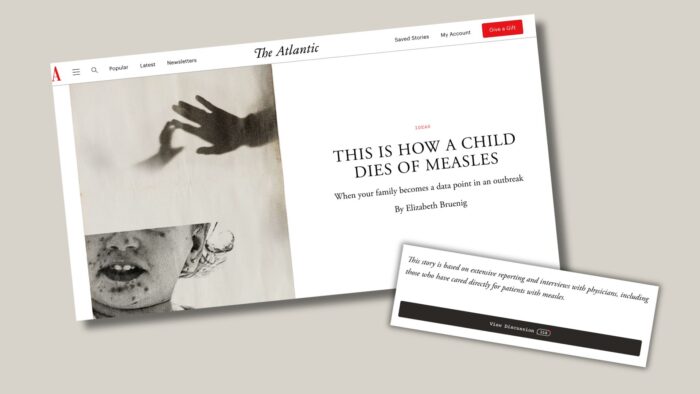
I hope there’s a sliver of a chance this reaches people who are really weighing these issues and making decisions about their children’s health in real time, or people who have friends and family weighing whether to vaccinate, or people living in communities currently managing outbreaks. I’m not very confident that it could persuade people who have very firm anti-vax convictions — as you point out, it seems pretty likely they would just blow it off. That’s always a risk anytime you write with a hint of persuasion in mind. But if the story makes even a little bit of a difference in even one person’s decision making where it comes to vaccines, then it was a success.
It's certainly possible to imagine such an audience — earnest, cautious, just-asking-questions types — being gripped by the vividly terrible course of events depicted in the story and effectively scared straight.
But it's also harder to imagine these parents than it probably should be. So just-doing-my-own-research that the sensible advice of doctors (and hell, even fake doctors from Season 1 of The Pitt) didn't land but maybe, just maybe they're still open-minded enough to trust a general-interest (if still highly fact-checked) consumer magazine? It feels like a stretch.
There does seem to be the possibility of a person recovering from years of Trump's "the media are the enemy of the people" and "fake news" rhetoric to say, "I read this thinking it was one thing, and now that I found out that it's something else, I don't trust you anymore."
Does that possibility invalidate the tons of research and interviews she did to write the story? I don't think so.
Does her justification for choosing the format in order to present as much of the information she found in the most compelling way possible hold water? Ultimately, I think so; I choose to believe people were continuing on mainly out of a sense of being pulled along by engaging writing and learning the horrible possibility of a disease we shouldn't be confronting in 2026, not "I need to find out who this is about — the author? A real-life mom?"
But the debate — in light of the media age we're living through, in light of the current administration's popular denouncements of the media, in light of a post-pandemic world, in light of a crumbling vaccine infrastructure, in light of an unconventional journalistic (and literary) approach that begs the question "Why did you do it that way?" — is one for the ages, and I'm jealous of the students getting to argue and disagree and test their own beliefs about what journalism can and should do for its readers.
Do yourself a favor: Read the story, read the interview and see what you think.
Comments