The Future of Tennis?
It’s been a brilliant fortnight of Wimbledon. (I’d say that most likely whatever had happened at the tournament, because I quite simply can’t get enough of the grass-court Grand Slam.)
The Ladies’ Championship Match was lacking some of the biggest names in the women’s game, but it was still a satisfying competition between Linda Nosková and Karolína Muchová.
Jannik Sinner and Alexander Zverev was perhaps a bit predictable the Gentlemen’s Championship Match, but the play was a consistently high level between two of the biggest names in the game. Zverev looked, at times, like a whole new player, powered by the confidence that only winning a major title could provide. Sinner reminded us why he’s No. 1 in the world. It was a great end to a great two weeks.
On the topic of biggest names in the game, I’ve been thinking a lot about a recent article in The Atlantic about the future of the game. In what’s essentially a quasi book review of journalist Matthew Futterman’s new book, The Cruelest Game: Chasing Greatness in Professional Tennis, Josh Levin provides an overview of the current state of the game, and I can’t tell what I think about it.
 Josh Levin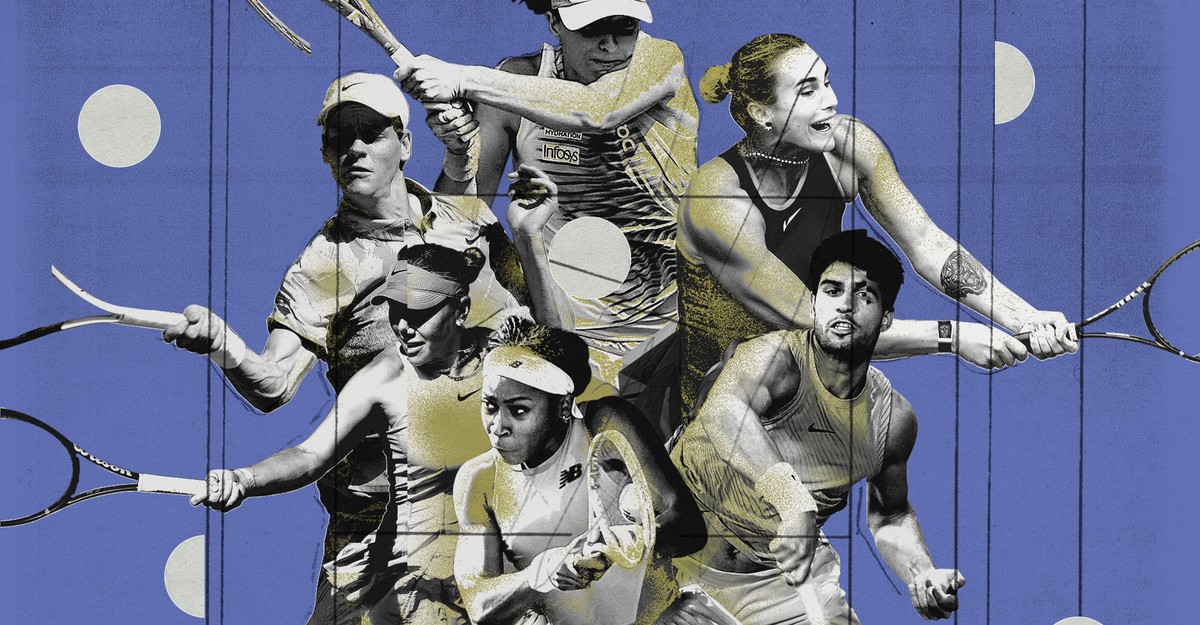
The top-line takeaway is: The game is hard, the environment that surrounds the game is undesirable, and the players — many of the stars, at least — are unhappy.
This bleak assessment is centered around the new generation of stars that have emerged in the vacuum left by the retirements of two of the game’s greats — Roger Federer and Rafael Nadal — and the twilight years of a still-scary-good Novak Djokovic, the lone remaining member of the Big Three, who defined (and dominated) the game for two decades. Futterman’s point seems to be that it’s a great time for these young stars, but the price they pay is something greater that what was required of the Big Three and their contemporaries.
I consider myself a pretty big tennis fan, but I don’t know that I’d be very interested in this book (at least not based on this article from a journalist whose work I usually adore).
What exactly am I responding to (or not, as it were)? Without having read the actual book (it’s due out in August) and without succumbing to some generational conflict that reduces all nuance to “The kids have gone soft” (as the Big Three aren’t just my formative generation of tennis but also are my contemporaries), I have to lay the blame at the publication’s feet. Put simply: I think it needed another edit.
We could start with the framing device of “Golden Age.” The headline (online) reads “Can Tennis Survive Its New Golden Age?” (The print version simply says “Tennis’s New Golden Age.”) But then the story’s first sentence reads: “The golden age of tennis didn’t end with a whimper.”
This, to me, suggests that it ended with a bang, then. It describes the retirements of two of the Big Three (plus Serena Williams’ retirement, as well). This is all setup for the real focus of both Futterman’s book and the article: the newest crop of A-list tennis stars. But based on the headline, I’m confused as to whether I’ve misread the story in the very first paragraph. Is Levin saying that the Golden Age of tennis didn’t end at all?
That seems silly. The heyday of the Federer-Nadal-Djokovic rivalries clearly was the sport’s golden age, and that’s behind us now. So the original assumption — that the opposite of “with a whimper” implies “with a bang” — seems to be the correct reading. I think it’s a tough starting point when the first line of the story adds confusion when read in conjunction with the headline and dek. To say absolutely nothing of the fact that, roughly midway through the story, there’s this line: “Financially speaking, this is the sport’s golden era.” Once again, I’m unsure which era of tennis is truly deserving of the label “Golden Age.” Is the headline’s “new golden age” this financial reality that’s emerged over the past four years, but in all other respects, the golden age ended with the opposite of a whimper when Federer and Nadal completed their Laver Cup match and quietly touched hands?
Moving on, there’s this bit, which seems to be the only explicit opinion expressed on the book’s quality:
The tennis ecosystem has unexpectedly thrived in the absence of Federer, Nadal, and Williams, but the gains—for the sport and for its marquee players—are far from secure. Although Futterman adeptly surveys tennis’s stressors, the shape of the crisis that tennis faces, and its stakes, eludes him. Everything about the professional game—the way it’s played, structured, and consumed—seems ripe for transformation.
Does that “eludes him” line mean readers shouldn’t bother because the observations, research, interviews, and analysis don’t merit our time and attention? And what does it mean for the rest of the article itself — is everything else presented after that line a collection of what Levin thinks the book lacks or fails to adequately address? Another few lines seem to suggest so — “Deep insights from the athletes themselves, in The Cruelest Game and in press coverage generally, are scant.” and “Although this variety of cruelty goes unaddressed in The Cruelest Game, Futterman does highlight the unprecedented physical toll of tennis circa 2026.” — but never does Levin come out and say “This book doesn’t quite land the plane.”
I could go on with editorial nitpicking around the structure and flow of this story that left me scratching my head, but I come back to where I started: I don’t very much want to read Futterman’s book after reading this story.
Which isn’t a bad thing, in itself. I love a clear-eyed critic’s review that points out why a person shouldn’t waste his time. My gripe with this particular story is that I can’t tell what it is and what it isn’t, what it’s for (if anything) and what it’s against (if anything). If it’s trying to get me interested in the book by singing its praises, it fails for a lack of conviction. If it’s trying to steer me clear of this book because it’s not very good, it fails as a matter of criticism. If it’s serving as a corrective to what it sees as lackluster reporting and analysis in the book, it’s not clear enough on the book’s defects to fulfill that role convincingly.
It feels like a setup for an easy overhead smash, but for some reason, the fundamentals have broken down and it ended up dumped into the net.
Comments